Categories
Uncategorized

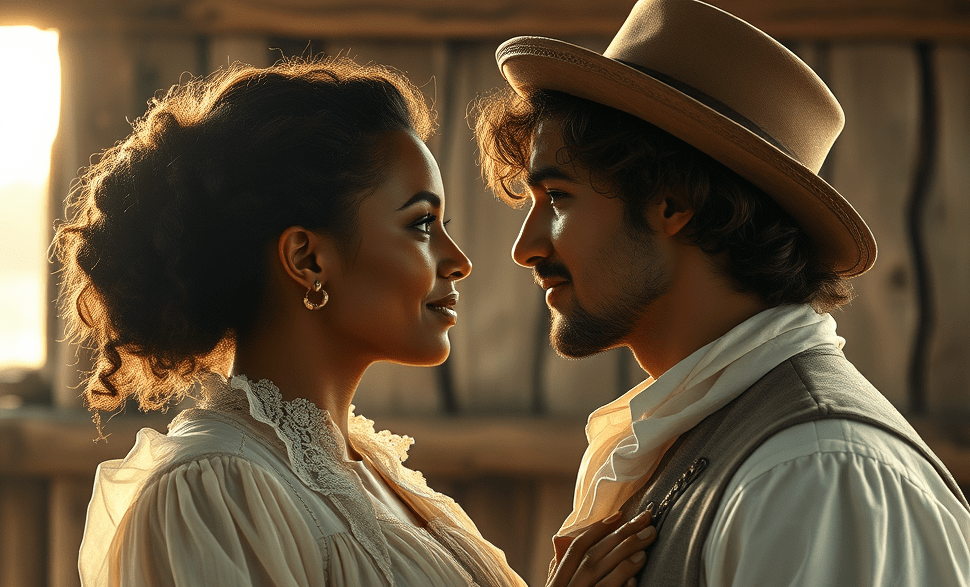
Love in 1860: Part 5

Love in 1860 (An Easy English Story): Part 5

February 25, 1861

Dear reader,

The snow is melting. I can hear more birds in the morning.

And I am going to leave this house in the spring.

My plan is simple. I don’t want to stay here anymore.

When the weather is warm, I will tell David and Elizabeth, “I am going to pick berries in the woods.” I will hide food under my skirt. I will leave and never come back.

We are living in Virginia. If I walk north, maybe I can go to New York. I think New York did not have slaves in 1861. In movies, some people hide on trains. Maybe I can find a train to New York. I can hide in the back with the animals. I can sleep in the hay.

After David talked with the neighbors in December, I did not talk with him for three weeks. He and Elizabeth were worried. They said, “Don’t be angry. We need to keep you safe. You are not our slave. But if other people know that you are not our slave, they will try to take you. A black woman living with a white family is not normal. Maybe you are from the north. Did any memories come back?”

Not normal.

My mom’s parents were from Nigeria. My dad’s parents were from England and Mexico. Mom and Dad got married in 1997. This life is very normal for me.

I can’t tell this to David and Elizabeth. They can’t know that I am from 2025.

Last week, David gave me a book. It had many pictures in it. “These are pictures of cities in the north. Maybe you can remember your home.”

I looked at the pictures. I pointed to a picture of New York City. “Maybe this was my home…” I lied.

After seeing that picture, I decided to leave after the winter.

Yours truly,
Grace Miller

Part 6>

Categories
Uncategorized

Love in 1860: Part 4

Love in 1860 (An Easy English Story): Part 4

December 2, 1860

Dear reader,

I am scared.

Our new neighbors came to our house this morning. I was making breakfast in the kitchen. They knocked on our door. David opened it.

“Can I help you?” David asked.

The new neighbors are a man and a woman. Both of them are about twenty years old. Their voices were friendly. “We’re your new neighbors,” the woman said. “We are building a house near the river. It’s nice to meet you.”

David quickly said, “It’s nice to meet you too.” He added, “Let’s go talk outside. I can show you our barn.”

It was snowing outside, so I turned around. “I just made breakfast,” I said. “Would you like to eat with us? Our kitchen table is small, but it’s warm inside.” I laughed, “David, it’s so cold out! Our new neighbors will freeze.”

The woman looked at me with wide eyes. She whispered to her husband. Then her husband asked David, “Your slave calls you David?”

Slave?!

David looked at the floor. “It’s okay. I asked her to call me David.”

The woman crossed her arms and looked at my clothes. “Her clothes are beautiful.”

“We’re having a party tonight,” David lied. “I want her to look nice for our guests.”

When the neighbors left, David closed the door and sighed. “I hope this war ends soon.”

“I’m not your slave!” I yelled and threw my wooden spoon at him. “Why didn’t you tell them?”

“If they know about our love, they might hurt you,” David said. “Don’t you know that?”

I’m not good at history. But even in 1860, I will not be anyone’s slave.

But I can’t leave David and Elizabeth’s house. Where will I go?

Yours truly,
Grace Miller

Part 5>

Categories
Uncategorized

See the World: Part 10

See the World (An Easy English Story): Part 10 (Final Part)

After the surgery, like always, Neil throws up. He doesn’t have time to take out the lenses, so he vomits with his eyes closed. If he sees the cells in his stomach, he will definitely throw up again.

Neil slowly stands up, takes out the lenses, and walks out of his office. The hospital’s hallways look orange in the sunset. Dr. Umar stands in front of a big window. She is crying and smiling. And talking to a news reporter. A cameraman points a large camera at them.

Dr. Umar notices Neil and waves to him. “Neil!” she calls. The cameraman turns toward Neil, and Dr. Umar tells the reporter, “This is Dr. Neil Kalkan. He just finished the cancer surgery with me.”

The reporter waves her hand, asking Neil to come closer. She holds up a microphone. “How does it feel to use such an amazing piece of technology? The lenses, I just…” she sighs excitedly, “can’t believe this is possible!”

The reporter pushes the microphone closer to Neil’s face. Neil is not wearing the lenses, but he imagines the germs on the microphone. Neon pink slime might cover the top of the microphone, even brighter than the reporter’s lipstick. Green spikes might swirl around the handle. Some of the reporter’s yellow breath might float toward Neil’s head. Dr. Umar’s shirt sleeve, covered in tears, might drip with purple and gray germs.

Dr. Umar’s tears flow down to the corners of her mouth. They might be filled with disease. But they are filled with joy. They are filled with life.

Neil breathes in deeply.

The world will never be the same. It will always be filled with spiky, slimy, moldy germs. People will always be weak, always be followed by sickness. But there will always be joy and hope.

Neil grabs the reporter’s microphone, stepping closer to her. “Using the lenses feels…” Neil cannot finish his thought. He grabs the microphone tightly as his eyes fill with tears. Through his tears, the orange sunset, Dr. Umar’s white coat, the reporter’s worried smile, the blue hallway tiles, the green patient chairs, his gray shoes–they all blur together.

-THE END-

Categories
Uncategorized

The Cold: Part 10

The Cold (An Easy English Story): Part 10 (Final Part)

We hear guns.

The police shout, “Come out of there now. If you run, we will shoot.”

More gun shots. Then it is quiet.

An ambulance drives by. Then another.

Priya and I wait. Three police cars eventually drive by. Each police car has two people in the back. In one of the cars, I see two of the men from the truck. One is the driver, and the other was carrying the boxes. I don’t see the other men. In the rest of the police cars, there are only women. One of the women shouts at the police officer from the back seat. The rest sit quietly. One looks out the window. Her face is red.

Priya knows what I am thinking. She says, “I think it’s safe. Let’s go. Maybe your dad is there.”

Priya slowly backs the car out from behind the wall. We drive to the large building. Many ambulances and police cars are still parked outside. A news van is also there. Cameramen walk around the building, filming the inside of the large trucks and the metal boxes that sit on the ground.

Police are opening each of the metal boxes. First responders stand behind them. They shake their heads. Police cover the boxes again.

One of the police officers walks toward our car. Priya rolls down her window. “This is a crime scene,” she says. “It’s not safe to be here.”

“My dad might be there,” I whisper.

The woman’s frown becomes soft. “How old is he?”

“50.”

“The people in the boxes are all at least 70.” The woman pauses. “There are more people inside, though. You can come check, but are you sure? Some of them are dead.”

My heart sinks. I don’t want to see Dad if he’s dead. But I want to be sure.

The police officer leads us into the large building. The inside is much cleaner than the outside. The walls and the floor are cold and white. The air smells like bleach. There are aisles of glass tanks. Inside the glass tanks are people. Their skin is puffy and light blue.

“These are the successful ice bodies,” the police officer explains quietly. “A few spas in Clayton are working with scientists. The scientists know how to freeze bodies and melt them after. They started to ask people with diseases if they wanted to be frozen. We looked at the patient information. The scientists kept records. They froze people with any health problem: cancer, diabetes, PTSD, depression. They especially tried to get people with depression. They sent them messages: Do you want to die, but are you afraid? You don’t have to die. Freeze your body and sleep until your problems are gone. People were interested in that.” She sighed. “Sleep until your problems are gone. It sounds great.”

Was Dad depressed? He was never the same after Alex died. He was quieter. He was angrier. I remember Dad’s note. I’m sorry, Alex. If I didn’t buy you that car, you would never have died. It’s all my fault.

I stop at one of the tanks. An old man lies inside. His eyes are closed. His face looks gray. His thin white hair floats in the tank.

I know him.

I saw him at the spa in the mall. He went there to be frozen? Why did he want to sleep? And did Dad go to that spa, too?

The police officer brings me to another room. It is small, like a doctor’s office. But it doesn’t feel like a doctor’s office. A frozen body of a young man lies on a table. Two women stand next to him. They are wearing white coats. Five police officers stand behind the women. They hold guns close to the women’s heads. The women quietly pass tools over the ice body. A yellow liquid is pumped into his veins. Slowly, his blue skin turns a light pink. “He just needs some time to wake up,” one of the women says.

The police officer with me walks over to the women. She points at me. “Her dad might be here. Find him and wake him up.” Her voice is deep, and the other police officers raise their guns. One of the scientists sighs and looks at me. “What is your dad’s name?”

“Henry Brooks.”

The woman looks through a stack of papers. She shakes her head. “Not here.”

The young man on the table opens his eyes. He begins crying for help. The scientists walk away from me and go back to help him.

I run out of the room.

The building is filled with hundreds of tanks. None of them are Dad. If his body isn’t in here, will he appear on the side of the road as an ice body? Will a young girl see his body out of the bus window? Will his arms and legs be covered in blue and purple marks?

I slow down and look at the faces. I notice that the names are in order. Martinez, McDonald, Murano… Maybe the scientist was wrong. Maybe she made a mistake. I need to check.

Bailey, Boushaki, Brenes...

I see him before I see the name.

Dad’s skin looks gray. I see the bones in his arms and legs. Even though he is sleeping, his face is tired. Even if he slept a thousand years, he would never feel alive.

I press my hand against the blue glass. “Dad…” I cry. I look down and see his name printed on the bottom of the tank. Alex Brooks. He used Alex’s name.

The police officer comes up behind me. “Is this him?” she asks. I nod. “Over here!” the officer shouts. She kneels down next to me and hugs my shoulders.

The two scientists use a machine and lift Dad’s tank into the smaller room. They carefully take his body out and lay it on the table. “Melting” him only takes an hour, but it feels like a week.

His skin turns from gray to a warm brown. I see his chest rise and fall as he breathes.

I run over to the table. My face is wet with tears.

I grab Dad’s hand. It is warm. Full of life.

His eyes open.

-THE END-
Categories
Uncategorized

See the World: Part 5

See the World (An Easy English Story): Part 5

Neil looks in the mirror and takes out the lenses.  The lenses are smooth and light just like regular contact lenses, but if Neil looks closely he can see thin wires in the lenses. They look like a spider web.  With the wires, Neil’s eyes can see cells and diseases.  A year ago, a man called Alvin Muller found a special part of the brain. Scientists now call it Muller’s Area. Animals like dogs and bees use Muller’s Area to “smell” diseases. Humans have Muller’s Area in their brains too, but it is weaker than in animals’ brains.  Alvin Muller created the lenses to send messages to Muller’s Area. Animals’ noses send messages to the brain when they “smell” disease. With the lenses, humans’ eyes can send messages to the brain when they “see” disease.  

Before the lens, scientists from Hunan used genome editing. They helped many people with diseases in their DNA.  Neil believes that genome editing is like fixing a car. When a person fixes a car, he does not destroy the car. Instead, he replaces the broken parts of it. For example, if the engine does not work, he takes out the engine and puts in a new one. In the same way, with genome editing, doctors can take out the diseased DNA and put in healthy DNA.

The scientists in Hunan were 99% successful. In every patient, genome editing destroyed most of the disease. But the scientists couldn’t find all of the disease inside the patients’ bodies. About 1% of the disease stayed in the body, and after a few months, the diseases became bad again.  That’s why Dr. Alvin Muller created the lens. The lens helped doctors find 100% of every disease.  

In a year, the lens was used for fourteen surgeries in different countries. All surgeries succeeded.  Today’s surgery was the fifteenth, and it was Neil’s first surgery with the lens.

Part 6>